Australia
All about asutralia
all you need to know
History about Australia
The ealiest human population arrived on the Australian continent more than 40,000 years ago when Indigenous tribes migrated from an unknown region of Asia. Australia’s Indigenous people have the oldest living cultural history in the world. Indigenous communities keep their cultural heritage alive by passing their knowledge, arts, rituals and performances from one generation to another speaking and teaching languages protecting cultural materials and looking after sacred and significant sites such as Uluru in the Northern Territory. Now Sydney, the largest city inAustralia. The colony grew as free settlers and migrants arrived in Australia hoping to make a better life.
all you need to know
About Australia

Australia
Australia, the smallest continent and one of the largest countries on Earth, lying between the Pacific and Indian oceans in the Southern Hemisphere. Australia’s capital is Canberra, located in the southeast between the larger and more important economic and cultural centres of Sydney and Melbourne.
Geography
Australia is 4000 kilometers wide (from the east coast to the west coast) and 3200 kilometres ‘tall’ (from north to south). It is split into six states and two mainland territories: Western Australia, Queensland, New South Wales, Victoria, South Australia, Tasmania, Northern Territory and Australian Capital Territory. Each state and territory has its own capital city, but the national capital of Australia is Canberra, which is located in the Australian Capital Territory.


Economy
The economy of Australia is a highly developed mixed economy. Its GDP was estimated at A$1.89 trillion as of 2019. In 2018 Australia became the country with the largest median wealth per adult, but slipped back to second highest after Switzerland in 2019.
Climate
Australia’s climate varies greatly across the country. About 40 per cent of the northern part of the country lies in the tropics. Monsoon winds bring moist air during summer, and the high rainfall between December and March is called ‘the wet season’. The climate in the southern part of the country is temperate, with cool winters, hot summers and four distinct seasons.

Culture and society
Australia is truly unique — it is the only country in the world that covers an entire continent and it is also the largest island in the world. Australia’s population currently stands at approximately 23 million people, with about a quarter of the population born overseas. Australia is also a secular country, meaning that there is no official religion. Each capital city has places of worship for religions from around the world. Australians value freedom, diversity, equality and peacefulness.
Population:
Australia has a population of just over 24.6 million people (as of August 2017), of whom about 50 per cent are female and 50 percent. Over a quarter of Australia’s population was born overseas, with most people immigrating from the United Kingdom, New Zealand and China. Australia prides itself on being a multicultural and diverse population.


Australian legal system
Australia’s legal system also known as ‘Common law system’ is based on the model which was inherited by those countries whose development was influenced by British Colonialism in particular the commonwealth countries and the U.S. Under the Australian legal system all people whether domestic or international are treated equally before the law and safeguards to ensure the unfairly judgment by government or officials.
Why study in Australia
all you need to know
AUSTRALIA: A GREAT CHOICE FOR STUDYING ABROAD

Australia
Coming to Australia to study is the perfect platform to build your future. With an Australian Student Visa, you can study in Australia at a high quality education institution and gain an internationally recognized qualification. Whether you want to improve your English or join one of Australia’s top universities, we can find the right course for you.
1. EXCELLENT EDUCATION SYSTEM:
Australia has one of the best education systems in the world. According to the University Ranking of Quacquarelli Symonds, the Australian National University, the University of Melbourne, the University of New South Wales, the University of Queensland, and the University of Sydney are among the 50 best universities of the world. Australian universities are always excited to welcome international students into their communities.


2. Any major is welcome:
Since Australia’s universities are some of the top ranked in the world, it’s no surprise that they offer a multitude of different degrees and majors. Whether you are studying engineering or English, medicine or Mathematics, there are plenty of different options and combinations to choose from when you study in Australia.
3. Easy access to student visas:
If you’re looking to get a student visa, Australia offers a streamlined process for the Student Visa (subclass 500). There are several requirements you will need to meet for your application to be approved, including being accepted into an educational institution and having sufficient financial capacity. You will also be required to get an appropriate level of health insurance for the duration of your stay.


4. Globally recognized qualifications:
Your degree from an Australian education provider can take you anywhere in the world. Studying here will boost your career prospects because graduates from Australia are desirable employees in any workplace. In most fields, an Australian qualification is recognised by employers throughout the world. Australian courses are constantly updated with input from industry leaders to ensure your skills and knowledge are current, strengthening your ability to compete for jobs.
5. Uncompromising quality assurance:
Australia sets the standard for excellence in educaton internatonally. Our education sector is based on a network of world-leading education providers, premium facilities, outstanding lecturers and student support services. This system was specifically designed for international students and refined over many years.


5. A great place to live and study:
Australia has a reputation as a safe place to live, with the streets and public spaces of Australian cities offering security and freedom not always found in other parts of the world. When you study here, you will join hundreds of thousands of students from Australia and around the world – including many from your home country – who are discovering new friends and exciting opportunities. We believe collaboration is key to our students’ success.
More Facilities
Incredible work opportunities:
Australia is a great place to work as an international student. You may choose to work while you are studying. This can be an option to earn extra spending money and get a taste of the local culture. Here are a few things to remember:
- Work hours: You can work up to 40 hours every two weeks while you are studying, and unlimited hours during holiday breaks.
- Workplace protections: You have the same protections at work as anyone else working in Australia.
- Minimum wage: You will get at least a minimum rate of pay per hour no matter what job you do.
- Strong support: You will find support every step of your journey as a student worker. Help is always available from government and private organisations as well as your education provider.
Ideal work for students:
The flexible hours and large number of opportunities in these industries make these ideal for students:
- Retail – including supermarkets, department stores, boutiques
- Hospitality – cafes, bars, restaurants, delivery
- Farming and fruit-picking – seasonal work
- Services – childcare, aged care and cleaning
- Administration and clerical work
- Tutoring
all you need to know
Working Rights:

Expand your work experience through volunteer work and internships:
Coming to Australia to study is the perfect platform to build your future. With an Australian Student Visa, you can study in Australia at a high quality education institution and gain an internationally recognized qualification. Whether you want to improve your English or join one of Australia’s top universities, we can find the right course for you.
Holiday work in Australia:
Australia offers several different types of visas for international students which allow you to work while you are holidaying or studying here. The Department of Home Affairs website has more information on working holiday visas.


Working in Australia after you graduate:
If you’re interested in staying in Australia to work after you graduate, you’ll need to get a new working visa before your student visa expires. As a graduated international student you may be eligible for:
- The Post-Study Work stream of the Temporary Graduate Visa (subclass 485) if you have completed a Bachelor, Masters or Doctoral degree.
- To submit an Expression of Interest through the Australian Government’s Skills elect, seeking approval to stay in Australia as a professional worker.
- State and territory government nomination for skilled and business migration.
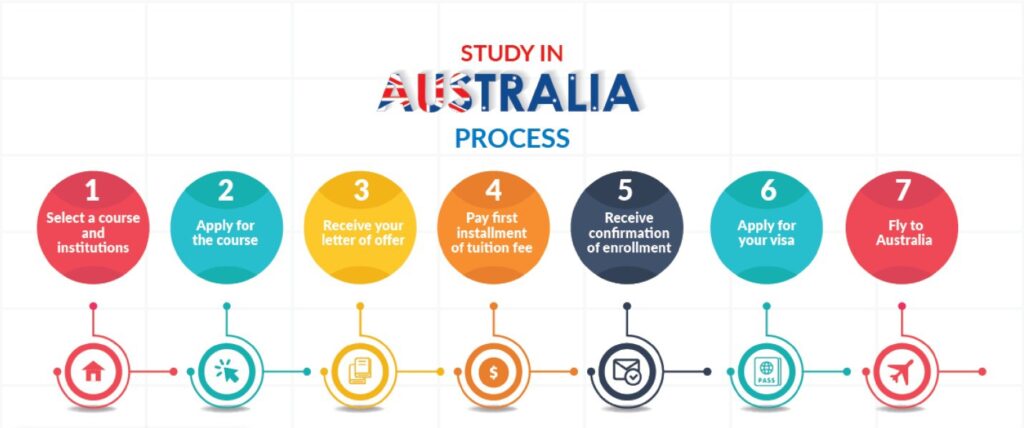
APPLICATION PROCEDURE
Required Documents:
- Your passport, valid for the duration of your studies plus one month.
- Two Photograph (With White Background)
- A letter of acceptance from a Canadian educational institution confirming name and length of the program, tuition fees, living expenses, semester for which the admission is valid and last date for registration.
- All educational documents, including marks sheets (SSC, HSC, Bachelors, Masters or other post- secondary, college, vocational or university diploma, certificate or degree).
- Proof of funds sufficient to cover your tuition and living expenses for your first year of study in Canada.
- You must provide a one year statement of transactions from personal bank account(s) (an original certified bank issued statement or a certified copy of passbooks), as well as fixed deposit certificates, savings certificates, PSP certificates or any other proof of savings.
- You must also demonstrate that sufficient funds will be available to support yourself during the whole duration of your program.
- Confirmation of any scholarship, grant, teaching or research assistantship including name of the providing institution or organization, amount per semester or year and duration.
- If some or the totality of your funds are provided by a sponsor (either parents or third party) you must also include:
- Notarized declaration of sponsorship. If you have more than one sponsor, a separate declaration must be provided for each sponsor. However, sponsors who are husband and wife can appear on the same declaration.
- Details of assets and income for each sponsor with supporting documents such as property documentation, land deeds, rent agreement, business license, business tax information, employment letter with salary information.
- You must also provide the income tax forms (tax assessments and tax paid receipts showing total income and amount of income tax paid) for the past two years.
- If someone other than yourself or your parents is providing funds you must include:
- Letter of explanation as to the reason why this person is assisting
- Number of persons living in this persons household
- Proof of this persons relationship to you; birth, marriage or school certificates, passport.
- Affidavits or self-declarations are not acceptable proof of relationship.
- Proof of employment for yourself, if applicable, and your parents (employer’s full name, address, phone number, name of supervisor with his phone number, length of service and salary details).
- Your police clearance certificate and your birth certificate
- Proof of Tuition fee payment
- Visa Application forms
- 2 complete photo copy sets of all the above attested and notarized.
Let’s Discuss Your Future at Off 2 Abroad
Join us to explore your study abroad options and see how our expert team can support your educational journey. We’re excited to help you achieve your global academic goals!